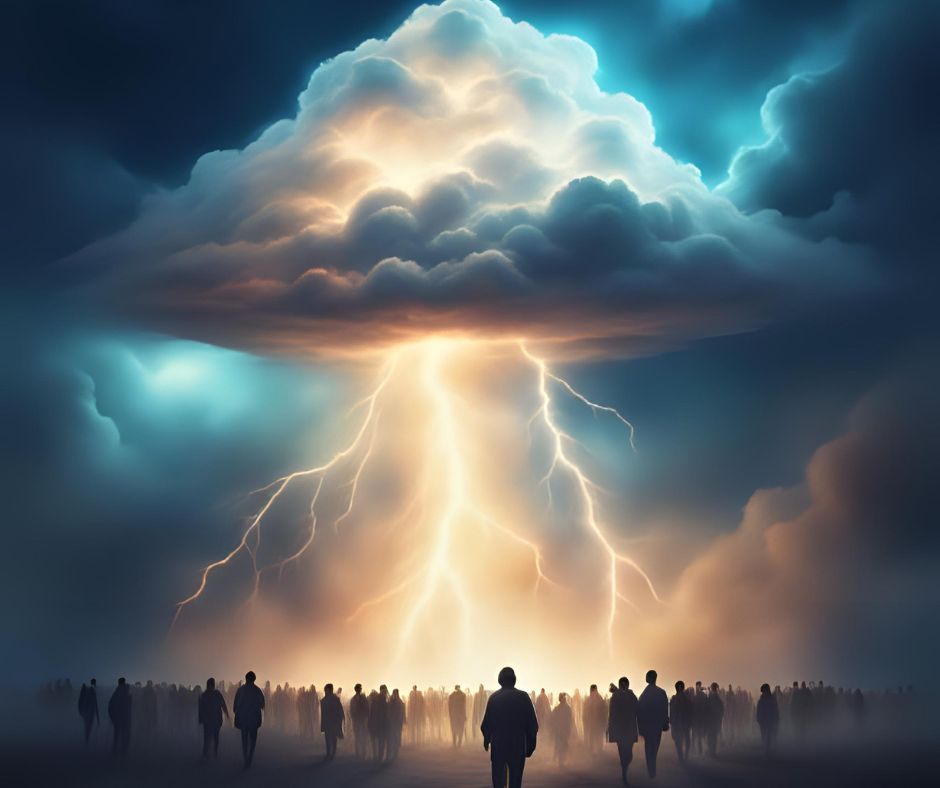
The setting: Israel (Cloud) is hesitant, torn with fear and grief, while God (Lightning) speaks through His Voice (Thunder) urging them to stand firm and fight against terrorists who attack them with divine assurance and prophetic gravity.
[Stage dark, a low rumble of thunder. Israel (Cloud) is kneeling, hands covering face, trembling with grief. A single spotlight falls. The sound of Thunder rolls like a voice from the heavens.]
Thunder (booming, divine): Israel… why do you falter? Why tremble in despair? Your enemies rise like shadows, yet you bow beneath their glare.
Thunder (resonant, unshakable): You mourn for sons and daughters slain, you fear the sword, the fire, the chain. But bodies break— [sudden crack of thunder] —the soul remains, eternal through loss, through blood, through pains.
[Israel raises head slowly, eyes filled with anguish.]
Thunder (commanding): I am God, the Lightning’s flame, the Lord of Hosts, the Holy Name. My voice is Thunder, fierce and true, I speak, O Israel— —I speak to you!
[Israel clutches heart, whispering, voice full of doubt.]
Israel (hesitant, breaking): But Lord… how can we lift the sword? How can we kill and still be Yours? Will not the blood of brother stain? Will not the innocent fall in vain?
Thunder (rolling, stern): Your hand is mine, your fight is just, I breathe through fire, I wield through dust. The foe is cruel, the wicked rise, they plot in darkness, with tongues of lies.
To shrink from war is to shroud My name, to turn from truth is eternal shame. Israel, rise—stand firm, stand tall, for I am with you, Lord of All!
[Lightning flash shakes the stage. Israel grips a spear or symbolic weapon, still trembling.]
Thunder (measured, mighty): Do not seek the spoils of strife, do not cling to mortal life. The harvest is Mine, the work is thine, strike with strength— [increasing power] —by My design!
Thunder (slower, echoing like prophecy): Be steady in sorrow, steadfast in pain, unyielding in loss, unbroken in gain. Like Zion’s mountain, like Jordan’s stream, you are My people, you are My dream.
[Silence. Then Thunder grows immense, cosmic, overwhelming.]
Thunder (roaring): I am Lightning—the fire, the flame, the storm, the silence, the source, the same! I am the breath of the beating sun, the Lord of Hosts, —the Holy One!
Time am I—the ceaseless breath, the womb of life, the wings of death. Nations crumble, empires fall, yet I remain— [thunder cracks] —the Lord of all!
[Israel rises to feet, voice shaking but growing louder.]
Israel (resolute, lifting arms): Then make us the storm, O God of light, make us Your sword, Your hand in the fight! Guide us in justice, guard us with flame, we fight, O Lord, in Your great name!
Thunder (triumphant, rolling across the stage): Yes, Israel—rise! Take your stand! You are the arrow in Lightning’s hand. Do not falter, do not delay, be the storm that clears the way!
Thunder (softer, reverent, almost tender): Surrender, Israel—not in defeat, but where mortal and Infinite meet. Let Thunder speak, let Lightning guide, and know My Spirit burns inside.
Thunder (final booming crescendo, echoing like judgment): For when you rise, and strike as one— the battle is over— the war is won!
[Lightning flash engulfs the stage. Sound of shofars (ram’s horns) blasts. Drumroll. Silence. Spotlight fades to black.]
An exploration of a modern 2024 phenomenon of “terrorism”. Investigating the origins/etymology of the word “terrorism” I discover that it comes from: “1795, in reference to Jacobins during the French Revolution, from French terroriste; see terror + -ist, and compare terrorism. Originally of state intimidation and government coercion by methods of terror” (Source etymology online)
Now, in 2024 that definition has totally been turned around to mean in Australia, “A terrorist act is an act, or a threat to commit an act, that is done with the intention to coerce. or influence the public or any government by intimidation to advance a political, religious or. ideological cause, and the act causes: • death or serious harm or endangers life.” (Source, livinggsafetogether.gov.au)
What if we are to apply the original definition to governments of today, no specific fingers pointed.
The term “terrorism” has evolved significantly since its origins in the French Revolution. While it was initially used to describe state-sponsored intimidation, its modern usage often refers to acts of violence perpetrated by non-state actors with the intent to intimidate or coerce a population or government.
Examples of modern-day state intimidation and government coercion, while not always explicitly labeled as “terrorism,” can include:
Surveillance and Mass Surveillance: Governments may use extensive surveillance programs to monitor citizens’ activities, potentially leading to intimidation and a sense of being constantly watched. Examples. CCTV, licence plate detection, mobile phone detection, speed cameras, Central Bank Digital Currency, Digital ID, Voice sign in, fingerprint sign in, facial recognition, PayWave, RFID,
Censorship and Restrictions on Free Speech: Governments may impose strict censorship laws or limits on free speech to suppress dissent and control public discourse. The Australian government misinformation and disinformation bill.
Intimidation of Political Opponents: Governments may use tactics such as harassment, threats, or imprisonment to silence political opponents or suppress opposition movements. The Australian government misinformation and disinformation bill.
Use of Force Against Protests: Governments may deploy excessive force against peaceful protests, leading to intimidation and a chilling effect on dissent. We have seen plenty of this in the state of Victoria, Australia as well as in Canada.
Economic Coercion: Governments may use economic sanctions or trade restrictions to pressure other countries or individuals into compliance, potentially leading to hardship and intimidation. Examples TAX, Fines, prison, people being debanked in many countries. Economic sanctions against Russia.
When we apply the strict definition, then surely the governments are the ones ruling by fear and intimidation.
The use of force or coercion by governments is a sensitive issue with varying interpretations and ethical considerations.
Terrorism typically involves violence or threats of violence intended to achieve political goals. So ask yourself today, is my government terrorising its people?
The Tale of the Dragon and the Butterfly
In a land under a dragon’s reign, Peace once flowed like a gentle stream. Wisdom and compassion graced its rule, Yet time’s embrace hardened scales with fear.
Walls rose high, rivers were dammed, The land’s vibrant heart grew dim. Eyes that once offered gentle watch, Now pierced through the lives of its people.
From a hidden garden, a butterfly emerged, Wings aglow with hope and freedom’s hues. It danced unaware of the darkened skies, Of the fear that clouded the land below.
Seeing shadows cast upon the joy, The butterfly fluttered toward the walls, Its delicate wings brushing against stone, Defying the dragon’s fiery wrath.
The dragon’s fire met with light, The butterfly’s wings shimmered bright. Its courage stirred the hearts of many, Questioning the dragon’s fearful might.
And so, the dragon withdrew in dread, Its roar now a whisper in the night. The butterfly’s flight, a spark of change, Proved even the small could challenge the dark.
The term “woke” has morphed from a call for awareness to a stifling dogma threatening free speech and critical thinking. While fighting for equality is undeniably important, the Wokerati’s brand of social justice has become a divisive force. Let’s dissect why:
Cancel Culture: Disagree with a celebrity’s past tweet? “Cancel” them! This intolerance stifles open discourse and drowns out dissenting voices. We can’t erase the past, but we can learn from it.
Identity Politics: Constantly judging individuals based solely on race, gender, or sexual orientation is not only reductionist, but also breeds resentment. We are all complex individuals – judging people based on group identity undermines that.
Safe Spaces: The constant push for “safe spaces” where nobody is ever offended creates a generation afraid of challenging ideas. True learning comes from open debate, not echo chambers.
Political Correctness Run Amok: Language constantly polices itself, erasing nuance and humour in the name of avoiding offence. This stifles creativity and can lead to unintended consequences.
The core message of “woke” – fighting for equality – is a noble one. But when it becomes an ideology focused on shaming and silencing, it backfires. We need to move beyond divisive labels and have open conversations. Real social progress comes from acceptance, respect, tolerance, unity, understanding, and a willingness to listen, not from performative outrage and public shaming.
Where to from Here?
Let’s reclaim the true meaning of social justice. Let’s focus on common ground and respectful dialogue. Let’s judge individuals based on their merit, actions and ideas, not their race or gender. Only then can we create a truly inclusive and tolerant society.
I have just finished reading Dr Thomas Sowell’s seminal work, “Intellectuals and Society,” in which the author posits a central thesis that challenges the undue influence of contemporary intellectuals on public discourse and policy. Sowell’s critique rests on several key premises:
1. Epistemological Hubris: Intellectuals, particularly those subscribing to specific ideological frameworks, often exhibit an inflated confidence in their knowledge and proposed solutions to societal problems. This overreliance on centralized planning and state intervention, Sowell argues, can have detrimental unforeseen consequences.
2. Empirical Neglect: He emphasizes the importance of grounding intellectual pursuits in robust empirical evidence and historical context. Criticisms are levied against intellectuals for selective data analysis, neglecting opposing viewpoints, and dismissing inconvenient realities that contradict their preferred narratives.
3. Idealistic Abstractions: The book contends that intellectuals are often drawn to utopian visions of social justice without adequately considering the complexities of real-world implementation and potentially negative downstream effects. Sowell champions a more pragmatic approach focused on achievable improvements informed by evidence and existing institutional frameworks.
4. Collectivist Biases: He criticizes the tendency of intellectuals to prioritize collective identities (race, class, gender) over individual agency, often attributing individual struggles solely to pre-existing systemic factors. Sowell advocates for a greater emphasis on personal responsibility and initiative as crucial factors in individual advancement.
While acknowledging the valuable role intellectuals can play in contributing insights and stimulating debate, Sowell ultimately calls for a more measured and evidence-based approach to intellectual discourse and policymaking. His core thesis prioritizes individual agency and pragmatic solutions over grand ideologies and simplistic diagnoses of societal issues.
However, it’s crucial to acknowledge that “Intellectuals and Society” has generated both praise and criticism. While some celebrate its critique of intellectual arrogance and its focus on historical context and individual agency, others have challenged its broad generalizations about intellectuals, its selective use of evidence, and its perceived ideological bias.
In order to wrap my head around the ides presented, I have written the following parable about an owl who gets rid of all the tree leaves so that the forest floor can receive an equal amount of sunlight.
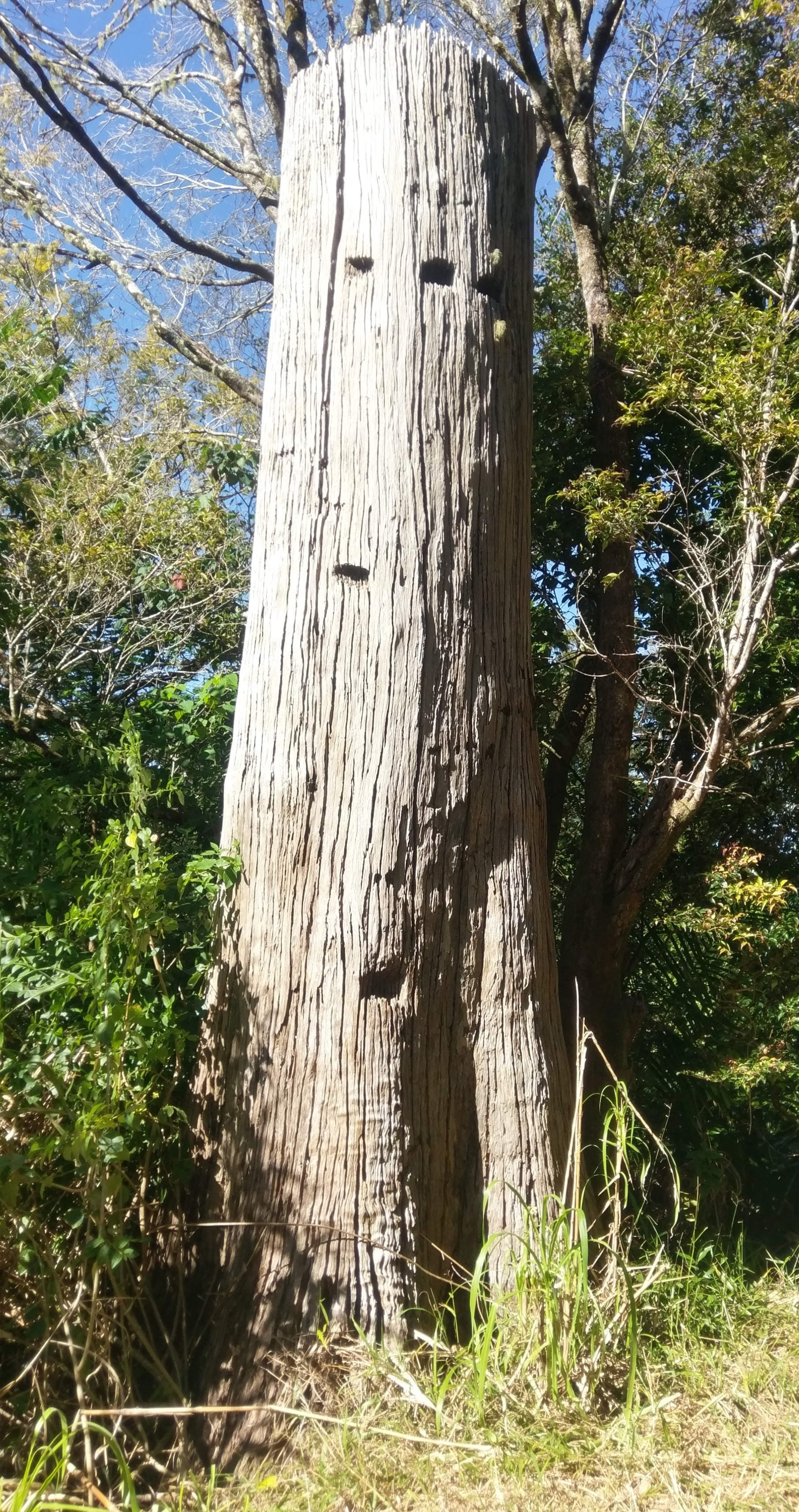
giant old tree stump
The Parable of the Owl who thought he knew better.
Or (The double edged sword of intellectual arrogance)
In emerald halls where sunlight dared not tread,
where ancient oaks held secrets whispering low,
Hootah the Owl, with wisdom’s crown upon his head,
Preached of shadows where the forest should not grow.
His feathered form, a tapestry of speckled night,
His voice, a siren’s song in boughs of aged might,
He spoke of trees that hoarded golden rays,
And creatures veiled in gloom, denied their rightful days.
The forest stirred, a ripple of discontent,
From timid mouse to stoic, lumbering ox,
Hootah’s words, a firebrand heaven-sent,
Ignited dreams of light beyond the locks.
He promised justice etched in sunlit lines,
A grand utopia where shadows dared not creep,
With shears of justice and with boughs entwined,
He vowed to banish gloom from slumber’s deepest sleep.
The rabbits danced, their fur ablaze with hope,
The squirrels clambered, eager to enforce the decree,
But Sowell the Ox, wise with seasons’ patient scope,
Felt doubt’s first tremor touch his ancient knee.
He’d seen the scars of grand designs laid bare,
The unintended thorn that grew with borrowed light,
The parched earth gasping ‘neath a denuded lair,
Where once the shade had held the sun at bay just right.
But Hootah’s fervor drowned the whispering fear,
His pronouncements rang like gongs upon the breeze,
And doubt was swept away, a tear uncried, unnear,
As branches were chopped, a sacrifice to sunlit ease.
And for a time, the forest shimmered bright,
The undergrowth, a canvas newly spun,
But soon the cracks of error came to light,
As withered branches mocked the rising sun.
The parched earth cracked, a thirsty song,
The rabbits searched for solace in the dust,
The squirrels clung to limbs, skeletal shadows long,
Their dreams of plenty transformed to disgust.
Then Sowell, voice a rumble from the ground,
Spoke truths etched deep in roots and ancient bark,
“Hootah’s grand design, with fetters tightly bound,
Can only steal the dance of darkness and the dark
Of nature’s own design, where sun and shade conspire
To weave a tapestry where life, in balance, thrives,
No single thread, however bathed in fire,
Can mend the broken loom where every creature strives.”
His words, a balm on fevered forest dreams,
Awoke the doubt that Hootah’s vision hid,
Squirrels’ lost their grip and rabbits’ angry screams,
A barrage of questions, unanswered by the whizz-kid
Hootah, perched upon his throne of withered pride,
Saw shadows creeping back to claim their due,
His grand design, by nature’s hand defied,
His promises dissolved like morning dew.
And so the forest healed, with lessons learned at last,
That harmony, not schemes, will guide the light,
That Sowell’s wisdom, whispered on the blast,
Is nature’s truest song, sung clear and bold and bright.
This tale, a whispered echo in the leaves,
A song of shadows woven with the sun,
Reminds that grand designs, like fallen sheaves,
May wither in the soil where balance has begun.
Can you help the Australian Poetry Film Contest?
Oz on Screen: A Poetry Film Feast in Guyra
Calling all poets and film fanatics! Get ready for the 2024 Australian Poetry Film Festival, a November bash celebrating words on screen in Aussie style. Imagine outback landscapes in motion, love poems whispered by waves, and bush ballads brought to life with modern magic.
This Guyra event welcomes everyone – young, old, poets, filmmakers, all! We especially love fresh takes on our rich bush poetry tradition. Think vibrant images, powerful verses, and stories that crackle with Aussie spirit.
Plus, the festival joins forces with “Poets on the Mountain,” so expect workshops, panels, and screenings under starry skies. It’s a creative melting pot where you’ll meet passionate folks and see the future of storytelling unfold.
But to make this poetry party pop, we need your help! We’re crowdfunding to boost prize money for Best Australian Poetry Film, Best Bush Poetry Film, and even Best Student Poetry Film. Every bit fuels filmmakers’ dreams and lets them share their visions with the world.
So, whether you write rhymes, love movies, or just adore Aussie tales, join us! Submit your film, donate to the cause, or simply come to Guyra in November and witness the magic. Let’s bring poetry to life, one frame, one verse, one epic story at a time!
For film submissions and crowdfunding details, visit:
When I looked in the mirror last year I didn’t like what I had become…..weak and overweight. This was not like how I want to see myself and it’s also not how I want other people to see me, As a father of sons and also a public figure it’s important to present an image of health and wellness as I have always been one to lead by example and not one to tell other people how to live their lives. I also have a father who has been a very good role model of what can happen when unhealthy dietary habits catch up on you as he had part of his bowel removed when I was young due to diverticulitis. So in my teenage years I adopted healthy eating such as fruit for breakfast and avoiding high energy, nutrient deficient processed food. One of my majors was environmental pollution and health so I have always tended to eat healthily and avoid chemical pollutants.
This year, 2023, I have leveled up my health and fitness training because I didn’t like the look of my reflection nor the numbers on the scales. So I restarted swimming 2 or 3 times per week, I am lifting in the gym 3 or 4 times a week as well as my daily breathing, meditation and yoga routine. I have also begun eating less bread and high glycemic index foods. The results are showing and although I’v only lost about 4 kilograms, most of the fat has been converted to muscle so I am visibly slimmer and stronger.
Why am I telling you this? The Guyra Ag Show is coming up and there are prize categories for Guyra Show Girl and Guyra Show Guy, I said half joking (because in all humility, I think I’d have a good chance at winning) that I could go in it to a friend. She was horrified and ranted about how the Australian of the year got her award for the work she’s done about “stopping the objectification of people. ” She was so insenced by the “Guyra Show Guy” competition that she said she was going to write to the “Guyra Show Society” She’s wrong, the Australian of the year is documentary director Taryn Brumfitt who leads the Body Image Movement, an Adelaide-based organisation that teaches people to look after, love and appreciate their bodies. It is a body positivity movement that Taryn Brumfitt leads.
This lead me to doing my own research on the objectification of people and looking at both sides of the argument. I will begin by arguing why the objectification of people can be harmful and then I explore arguments why is is OK for a man to objectify himself and then how self objectification by women is sexually empowering.
Why objectification of some people is harmful.
The objectification of individuals, regardless of gender, is a harmful practice that reduces a person to nothing more than a physical object for others to admire or desire. However, the objectification of men and women is different in both its form and consequences.
The objectification of women has been a widespread issue for centuries and is still prevalent in today’s society. Women are often objectified through the media, advertisements, and other forms of popular culture, where they are shown as passive objects for the male gaze. This type of objectification often sexualizes women’s bodies and reduces them to nothing more than objects for sexual pleasure. The consequences of this type of objectification can be damaging to a woman’s self-esteem, self-worth, and can lead to a negative body image.
On the other hand, the objectification of men is a more recent phenomenon that has been brought to light in recent times. Unlike the objectification of women, which often sexualizes their bodies, the objectification of men tends to focus on their physical strength and athleticism. This can be seen in advertisements and media that depict men as strong and muscular, promoting a particular type of masculinity. While this type of objectification may seem less harmful, it can still have negative consequences. For example, it can contribute to the pressure on men to conform to a particular body type, leading to anxiety and body shaming.
Furthermore, while both men and women are objectified, the consequences of this objectification are not equal. The objectification of women is often tied to sexism, misogyny, and the patriarchal system, which is why it can lead to gender-based violence and discrimination. On the other hand, the objectification of men is tied to toxic masculinity and the pressure to conform to traditional masculine gender roles, which can lead to harmful behaviours such as aggression and the suppression of emotions.
In conclusion, the objectification of men and women is different in both its form and consequences. While both are harmful, the objectification of women is can be tied to sexism and misogyny, while the objectification of men can be tied to toxic masculinity. It is important to acknowledge these differences and some people think it is important to work towards ending the objectification of all individuals, regardless of gender. This could be achieved through the promotion of body positivity, challenging harmful societal norms and expectations, and educating people about the harmful consequences of objectification.
How self objectification by men promotes body positivity.
The objectification of individuals, whether it is someone else objectifying them or themselves, is often seen as a negative and harmful practice. However, there is a growing argument that self-objectification can be a positive and empowering experience for some individuals, including men. In this essay, I will argue that it is okay for a man to objectify himself and explain why.
Self-objectification is a process in which an individual evaluates themselves based on their physical appearance and sexual desirability. For men, this can involve striving for a particular body type or physical appearance that they believe will make them more attractive to others. While this may seem like a negative practice, some argue that it can be a form of self-expression and a way for men to assert their individuality and control over their bodies.
For example, some men may objectify themselves in order to feel more confident and assertive. By focusing on their physical appearance and striving to achieve a particular body type, they may feel a sense of pride and empowerment. This can lead to improved self-esteem and a more positive body image, which can have a positive impact on mental health and well-being.
Moreover, self-objectification can be a way for men to express their sexuality and explore their sexual desires. By focusing on their physical appearance and sexual desirability, they may feel more comfortable and confident in their sexual identity and expression. This can lead to a more fulfilling and enjoyable sexual life, which is an important aspect of overall well-being.
It is also important to note that self-objectification is a personal choice and individual experience. While it may not be right for everyone, it is important to respect an individual’s right to choose how they want to present themselves and express their sexuality. The pressure to conform to traditional masculine gender roles can be harmful and restrictive, and self-objectification can provide a space for men to reject these norms and assert their individuality.
In conclusion, while the objectification of individuals is often seen as a negative and harmful practice, it is okay for a man to objectify himself. This can be a form of self-expression, a way to assert individuality and control over their bodies, and a way to explore their sexuality. As long as it is a personal choice and not used to harm others, self-objectification can be a positive and empowering experience for some men.
Can Self Objectification by Women be Sexual Empowerment?
The objectification of individuals, particularly women, has long been seen as a negative and harmful practice. However, in recent years, there has been a shift towards a more accepting and even celebratory view of women who objectify themselves. This essay will explore why it is becoming more acceptable for a woman to objectify herself.
One reason is the rise of the body positivity movement, which encourages individuals to love and embrace their bodies, regardless of shape or size. This movement has challenged traditional beauty standards and encouraged people to see their bodies as something to be celebrated rather than criticised. This has created a more accepting and inclusive environment for women who choose to objectify themselves, whether it is through posting sexy selfies or showing off their bodies in tight-fitting clothing
Another reason is the increasing visibility and representation of women in popular culture, who objectify themselves. From music videos to reality TV shows, women are increasingly presenting themselves in sexually suggestive and provocative ways. This has led to a normalisation of women objectifying themselves, and a greater acceptance of this type of self-expression.
Furthermore, the rise of social media has allowed for women to have greater control over their self-presentation and objectification. Through platforms such as Instagram, women can curate and control their online image, and choose to present themselves in a sexually suggestive or objectifying way if they so choose. This has given women greater agency over their self-expression and has made it more acceptable for them to objectify themselves.
It is also important to note that self-objectification can be a form of empowerment and self-expression for some women. By choosing to present themselves in a sexualised or objectifying way, they are asserting their individuality and control over their bodies. This can lead to a greater sense of confidence and body positivity, which can have a positive impact on mental health and well-being.
In conclusion, it is becoming more acceptable for a woman to objectify herself due to the rise of the body positivity movement, the increasing representation and visibility of women who objectify themselves in popular culture, and the greater control and agency provided by social media. While self-objectification may not be right for everyone, it is important to respect a woman’s right to choose how she wants to present herself and express her sexuality.
Poetry: When Body Positivity Meets Gaslighting.
When body positivity meet gaslighting. (Satire) While researching for the above article I came across some phrases used to promote body positivity and also some phrases used to “body shame” and thought what would happen if you combined the body positivity phrases with the body shaming phrases. This is meant purely as satire.
“You are beautiful just the way you are but you’re too skinny/fat”
“Your body is amazing and you need to lose weight”
“Although you’re not toned enough you are worthy of love and respect, regardless of your size or shape.”
“Your body is a temple with love handles and cellulite treat it with care and respect.”
“You are more than your appearance and your flabby arms and legs.”
“Your body is strong and capable even with a muffin top.”
“Embrace your unique features, imperfections and thick waist, they make you who you are.”
“Focus on what your body can do, not your small breasts, big butt and double chin..”
“Health and happiness are more important than any physical characteristic like your ugly face”
“Your body is a work of art with a big belly, created perfectly for you.”
“Be kind to yourself and your body, it’s the only two you have. “
“Your body and thunder thighs are a reflection of the amazing person you are.”
“You need to work on your abs and acne but you are enough, just as you are.”
“Every body is a good body except that you have bad posture.”
“Your body is a source of pride and joy with a pot belly”
“You deserve to feel confident and comfortable in your own dry, flaky and wrinkly skin.”
“Celebrate your body for all the amazing things it allows you to do like sit and watch TV.”
“Focus on nourishing and loving your body, not changing your flat butt.”
“Your body is perfect in its own unique way with that squashed face and no teeth. “
“Remember, beauty comes in all shapes and sizes even very wide hips.”
And that is that…. Except the last thing that I wanted to say is that we are currently in the most unhealthily obese period in human history with over 50% of the entire population of the planet overweight or obese. That sure is one big opportunity for improvement. Stay well and let me know what you think in the comments.







 Thundercloud Repairian