animals, book, poetry

Dive into the Surreal: A New Zine of Poetry and Art

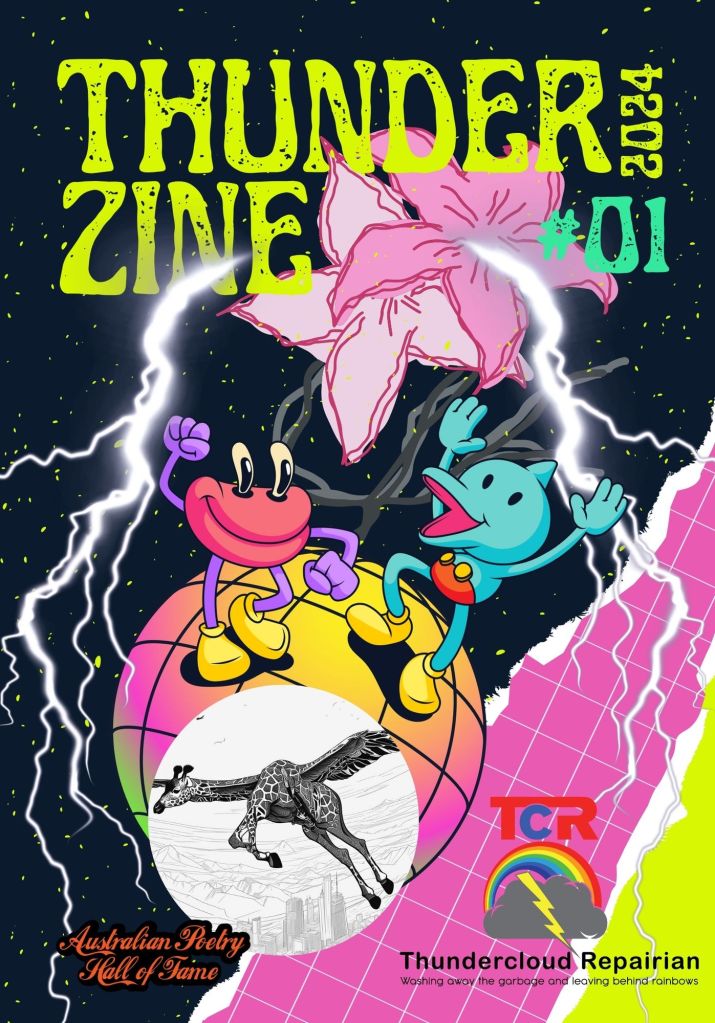
Thunderzine #01 Out Now

Explore the vibrant and colourful surreal poetry and artwork of Thundercloud’s Thunderzine#01

Are you ready to embark on a journey beyond the ordinary? My latest creation, a zine brimming with surreal poetry and art, has just been released!

This unique offering is a playground for the imagination. Within its pages, you’ll encounter poems that dance with dreamlike imagery and art that bends reality in captivating ways. It’s a space to lose yourself in the beauty and absurdity of the surreal.

Calling all fans of the strange and wonderful!

Whether you’re a seasoned explorer of the surreal or just dipping your toes into the unknown, this zine is for you. It’s a chance to experience the world through a different lens, to be surprised and delighted by the unexpected. You will discover what it is like to become a flying giraffe amongst other things.

Want your own copy?

For just $5 plus postage, you can own a piece of the surreal. Contact me directly at 1english1@gmail.com to secure your copy.

Don’t miss this opportunity to delve into a world where the ordinary is defied and the extraordinary takes centre stage. Let my surreal zine ignite your imagination and transport you to a place where anything is possible.

Get your own copy of the artwork or have it shipped directly to you. Don’t miss out on this unique artistic experience! #SurrealArt #Thunderzine #ArtExhibition #AustralianPoetry #ColourfulArt #ArtCollectors #CreativeCommunity #ArtLovers #PsychedelicArt #ArtInspiration

animals, change, health, Life lessons

Replacing Habits: Pulling Bad Habit Rabbits Out for Positive Change

Download begins 1 January 2020 12:34am.

Thirty Four minutes into New Years Day, admittedly I had taken a gut full of magic mushrooms and the download occurs. “We are all born with 100 bad habit rabbits up our bum and when they are hungry they stick their heads out and growl. We feed them and they lay content and silent until they reawaken. The goal, shit them out and replace them with happy good habit rabbits that you need to feed.” (Thundercloud Wisdom)

Two days later, I left Rose, Fantasian Eatery our restaurant in Nimbin and went home to begin publishing the poetry that I had written. Jump forward twelve months and I am now living in Guyra running the Australian Poetry Hall of Fame and on the 1st of January 2021 I wrote the following poem.

The Rabbits

A Resolution Was made to shit out my rabbits

The bad habit rabbits and grow good habit rabbits

Because new good habits were what I needed to do

I said “Hasta la Vista baby” on January Two

“see you later princess, I’ve Dragons to slay

So you’re dropped like a bad habit, I’m going away”

I took my peace and love then left with a BOOM

Left a bad habit rabbit ranting in her dining room

Shat a bad habit rabbit out when I did a poo

Fed a new good habit rabbit in its place it grew

Found a town where the new good habit rabbits walked around

Settled down and said farewell to bad habit rabbit town

Make my bed in the morning, exercise and clean my room

All because last new years eve I ate a blue mushroom

The message from the mushroom was something like this

Shit out your bad behaving rabbits and they won’t be missed

Feed your good habit rabbits lettuce and sit them in the sun

Because good habit rabbits love feeling good and also having fun

Another year is here and time to shit me rabbits

Introspect, self reflect and eliminate old bad habits

Plant new good habit rabbit seeds after my last fart

Nurture them and water them with love from my heart

Going forward in the year with good habits that are new

New healthy behaviours adopted and grown by 2022

Here we are in 2024 and one of the bad habits that I had fallen into was waking in the morning and scrolling short videos before I get up to do my yoga and meditation. Upon identifying this pattern I decided not to look at my phone until after yoga and then go for a walk and listen to “Headway” book summaries. Some of the summaries that I have listened to are: “The Power of Habit” by Charles Duhig, “The 7 Habits of Highly Effective People by Stephen R. Covey and “Atomic Habits” by James Clear.

I have provided a summary below of what I have learnt so far and finish with my latest piece of “habit poetry” “Rabbits Part 2”

Pulling the Bad Habit Rabbits Out of My Ass

 Outline

1. Introduction

   – Overview of the metaphor

   – Importance of habits in daily life

2. Understanding Bad Habits

   – Definition of bad habits

   – Examples of common bad habits

3. The Metaphor of Bad Habit Rabbits

   – Explanation of the metaphor

   – Why visualise habits as rabbits?

4. Identifying Your Bad Habit Rabbits

   – Self-awareness and self-assessment

   – Techniques to identify bad habits

5. The Impact of Bad Habits on Life

   – Physical health consequences

   – Mental and emotional effects

   – Social and professional impacts

6. Why It’s Hard to Get Rid of Bad Habits

   – The science behind habit formation

   – Psychological attachment to bad habits

7. Pulling the Bad Habit Rabbits Out

   – Strategies for breaking bad habits

   – Real-life examples of habit breaking

8. Replacing Bad Habit Rabbits with Good Ones

   – The concept of healthy rabbits

   – Steps to replace bad habits with good ones

9. Conditioning the Good Habit Rabbits

   – Importance of conditioning

   – Techniques for maintaining good habits

10. Feeding the Good Habit Rabbits

    – Consistency in good habits

    – Positive reinforcement methods

11. The Role of Support Systems

    – Family and friends

    – Professional help and therapy

12. The Journey of Self-Improvement

    – Setting realistic goals

    – Tracking progress

13. Success Stories

    – Inspirational stories of habit transformation

    – Lessons learned from others

14. Common Mistakes in Habit Change

    – Pitfalls to avoid

    – Tips for overcoming setbacks

15. Conclusion

    – Summary of key points

    – Encouragement for continuous self-improvement

16. FAQs

    – How long does it take to break a bad habit?

    – What are some effective methods for habit change?

    – Can bad habits be completely eliminated?

    – How do I stay motivated during the process?

    – What if I relapse into old habits?

 Pulling the Bad Habit Rabbits Out of My Ass

 Introduction

We’ve all heard of pulling rabbits out of hats, but pulling bad habit rabbits out of your ass? Now that’s a trick worth learning! Habits, whether good or bad, significantly shape our daily lives. This whimsical metaphor illustrates the struggle of getting rid of pesky habits that do us no good and replacing them with ones that enrich our lives.

 Understanding Bad Habits

Bad habits are those repeated actions or behaviour that negatively impact our lives. They can range from smoking and overeating to procrastination and excessive screen time. While these habits might offer temporary comfort or satisfaction, their long-term effects can be detrimental.

 The Metaphor of Bad Habit Rabbits

Why visualise habits as rabbits? Because rabbits are prolific and, when unchecked, can multiply rapidly. Just like these furry creatures, bad habits can quickly take over various aspects of our lives if not managed. Seeing these habits as rabbits makes the concept tangible and helps in visualising the process of removal and replacement.

 Identifying Your Bad Habit Rabbits

The first step in breaking free from bad habits is self-awareness. Take a moment to reflect on your daily routines and identify actions that negatively impact your well-being. Keep a journal or use habit-tracking apps to pinpoint these behaviour. Techniques such as mindfulness and meditation can also aid in recognizing these habits.

 The Impact of Bad Habits on Life

Bad habits can wreak havoc on your physical health, leading to issues like obesity, heart disease, and chronic fatigue. Mentally, they contribute to stress, anxiety, and depression. Socially, they can strain relationships and hinder professional growth. Recognizing these impacts underscores the urgency of addressing them.

 Why It’s Hard to Get Rid of Bad Habits

Breaking bad habits is challenging because they are deeply ingrained in our neural pathways. The brain loves routine, and changing these patterns requires significant effort. Additionally, bad habits often provide immediate gratification, making it harder to resist their allure.

 Pulling the Bad Habit Rabbits Out

To effectively pull out these bad habit rabbits, you need a strategy. Start by identifying triggers and replacing the habit with a healthier alternative. For example, if stress triggers you to smoke, try taking a walk instead. Gradual reduction and positive reinforcement can also be powerful tools. Real-life examples include people who successfully quit smoking by gradually reducing their intake or replacing it with nicotine patches.

 Replacing Bad Habit Rabbits with Good Ones

Once you’ve yanked out those bad habit rabbits, it’s time to bring in the good ones. Healthy habits can include regular exercise, balanced diets, reading, or even daily meditation. Start small and build on each success. For instance, if you want to start exercising, begin with a 10-minute walk each day and gradually increase the duration.

 Conditioning the Good Habit Rabbits

Conditioning is crucial for maintaining these good habits. Consistency is key. Set a schedule and stick to it. Use reminders and set achievable goals. Celebrate small victories to keep yourself motivated.

 Feeding the Good Habit Rabbits

Just like rabbits need food to thrive, good habits need consistent effort. Positive reinforcement, such as rewarding yourself for sticking to a habit, can strengthen your commitment. Surround yourself with positive influences and avoid environments that trigger old habits.

 The Role of Support Systems

No one is an island, and having a support system can make a huge difference. Share your goals with friends and family. Join support groups or seek professional help if needed. Therapy can provide tools and techniques for dealing with deeply rooted habits.

 The Journey of Self-Improvement

Self-improvement is a continuous journey. Set realistic goals and track your progress. Celebrate milestones and don’t be too hard on yourself if you slip. Remember, every step forward, no matter how small, is progress.

 Success Stories

Hearing from others who have successfully transformed their habits can be incredibly motivating. Look for inspirational stories and learn from their experiences. These narratives can provide valuable insights and encouragement.

 Common Mistakes in Habit Change

Changing habits is not a linear process. Common mistakes include setting unrealistic goals, not having a clear plan, and not seeking support. Avoid these pitfalls by being patient with yourself and adjusting your strategies as needed.

 Conclusion

Pulling the bad habit rabbits out of your ass and replacing them with good ones is no small feat, but it’s entirely possible with the right mindset and strategies. Start small, stay consistent, and seek support when needed. Your journey towards better habits is a marathon, not a sprint, so pace yourself and enjoy the process.

Bad Rabbits

Pulling the bad habit rabbits out of my ass

I feel so much more comfortable after they pass

Replacing them with healthy rabbits like conditioning

Feeding the good habit rabbits like going to gym

I took out a bad habit rabbit, had an empty feeling

Replaced it with a good habit rabbit as part of my healing

I used to sit and watch, now I plan, act and do

Fast and eat much less and I have more energy too

But there are still bad habit rabbits screaming inside

FEED US We are your dark side you cannot hide

There are times that I feed them just to shut them up

And then I justify to myself that it’s ok to fuck up

It’s not because personal growth is a journey of every day

Change and self improvement in each and every way

And those bad habit rabbits are just patterns learned

Good habit rabbits come from willingness to grow, change, and lessons learnt

 FAQs

How long does it take to break a bad habit?

Breaking a bad habit typically takes anywhere from 21 to 66 days, depending on the individual and the habit.

What are some effective methods for habit change?

Effective methods include identifying triggers, replacing the habit with a healthier one, and using positive reinforcement.

Can bad habits be completely eliminated?

While it’s challenging to completely eliminate a habit, it can be significantly reduced and managed with the right strategies.

How do I stay motivated during the process?

Staying motivated involves setting realistic goals, celebrating small victories, and seeking support from friends, family, or support groups.

What if I relapse into old habits?

Relapses are common. Don’t be too hard on yourself. Reflect on the triggers that caused the relapse, adjust your strategy, and keep moving forward.

animals, change, Life lessons

Yes-men, groupthink and lemmings

Critical thinking, questioning and robust debate are an essential element of innovation, positive change and progress in a society. Being immune to the unfounded opinions of others is essential to engaging in positive social change as opposed to “lemmings” who blindly follow their leaders into oblivion as all the “great” empires have done from Rome to the current collapse we are witnessing with the current collapse and disintegration of the US financial/military/industrial/oligarchic plutocracy. However this phenomenon not just confined to the US and all bureaucratic institutions from government to business, from political factions to the multiple tribal groupings of humanity.

The phenomenon of “yes-men” and “groupthink” even happens amongst so called alternative and progressive “tribal” groups to result in the “self censoring” as discussed below. However lets begin with a fable:

Oh, the yes-men donkeys, they slaved all day, 

Pulling carts and wagons, in the farmer’s way. 

The farmer was stern, and he loved his stick, 

He used it to beat them, when they weren’t quick.

But one day, a new donkey came along, 

He was bright, cheerful and sang a new song. 

He said, “Dear donkeys, there’s a better way, 

To work hard and fast, all through the day.”

“Instead of the stick, let’s use a carrot, 

A reward for hard work, it’s a better start.” 

The other donkeys just laughed and jeered,

 “We don’t need carrots, that stick isn’t feared.”

They were so caught up in their groupthink, 

They couldn’t see the carrot, nor even wink. 

The new donkey was sad, but didn’t give up,

 He knew that someday, they’d fill his cup.

One day, the farmer decided for the best, 

To try the new donkey theory, put it to the test. 

So put him in a field with a carrot, no stick, 

Watched that donkey working quite very quick.

The new donkey worked hard for the carrot, 

And munched away, like a hungry parrot. 

The farmer was amazed, he’d never seen, 

A donkey working this hard, it seemed like a dream.

The farmer decided to try out the carrot, 

With the other donkeys and put it on a hook. 

But the other donkeys still preferred the whip stick, 

Caught up in their groupthink and mentally sick. 

The farmer was disappointed, but he learned a lot, 

He learned about groupthink’s mindset rot. 

Leading yes-men donkeys to make bad decisions, 

Missing opportunities for change with absolute precision.

It’s important to be open to new donkey’s ideas,

Stand up, challenge the status quo, without fears. 

And the best way to get people to work hard, 

Is to reward them, not punish them right from the start. 

Yes-men are people who are known for always agreeing with the people in power, even when they have their own doubts or concerns. Yes-men are often seen as being sycophants or flatterers, and they can be very dangerous, especially when they are in positions of power themselves.

Groupthink is a psychological phenomenon that occurs when a group of people makes bad decisions because they are all trying to conform to the group’s consensus. Groupthink can be caused by a number of factors, including:

  • Illusion of invulnerability: The group believes that it is infallible and that its decisions are always correct.
  • Collective effort to suppress dissent: The group exerts pressure on its members to agree with the consensus, even if they have different opinions.
  • Self-censorship: Group members are afraid to express their dissenting views because they fear being ostracised or punished by the group.

Yes-men can play a major role in groupthink. Because they are always agreeing with the people in power, they can create an environment where dissenting views are silenced and bad decisions are made.

Here are some examples of how yes-men and groupthink can lead to bad decision making:

  • A corporate board of directors may make a bad decision about a merger or acquisition because the CEO has surrounded himself with yes-men who are afraid to challenge his ideas.
  • A government administration may make a bad decision about going to war because the president has surrounded himself with advisors who are afraid to tell him that he is wrong.
  • A sports team may make a bad decision about a trade or draft pick because the general manager has surrounded himself with scouts and coaches who are afraid to tell him that he is making a mistake.

It is important to be aware of the dangers of yes-men and groupthink. If you are in a situation where you feel pressured to conform to the group’s consensus, it is important to speak up and express your own opinion, even if it is different from the majority opinion.

Here are some tips for avoiding groupthink:

  • Encourage dissenting opinions.
  • Be open to new ideas and perspectives.
  • Take time to reflect on decisions before making them.
  • Avoid making decisions under pressure.
  • Seek input from outside the group.

By following these tips, you can help to ensure that your group makes better decisions.

Lemmings leap and play their part

A runny fart is called a shart

The narrative is the dominant paradigm

Questioning the narrative is not a crime

Critical thinking and research

Makes a lot of peoples brains hurt

as it’s simple not to think for oneself

Lemmings following lemmings isn’t great for lemmings health

The narrator is hidden behind a mask of deception

Misinformation censorship and misdirection

It’s easy floating along in a dream

Takes effort to swim and row upstream

Questioning the narrative and asking “what if”

this river is a waterfall going off a cliff

The Cretin Notelligence Agency taken to task

Own all the media puppets in a mask

Saying, “jump off a cliff and you will fly

if you wave your arms about you won’t die”

Jump off the cliff and I’ll give you a dime

Is the narrative of the dominant paradigm

animals, poetry, writing

What’s a “bogan” dad?

The term “bogan” is a term that originated in Australia and has been used to describe a particular subculture within the country. The word has been in use for several decades and has undergone a number of transformations in meaning over time.

The exact origin of the term is uncertain, but it is thought to have first been used in the 1970s as a slang term to describe a person who was perceived as being unrefined or lacking in taste or cultural awareness. This person was typically seen as being working-class and having a distinctive Australian accent. The term was often used to describe people who lived in the suburbs or outer regions of cities, as well as those who were involved in motor sports or other working-class pursuits.

Over time, the meaning of the term “bogan” has evolved and become more complex. While it still retains its original connotations of being unsophisticated and lacking in taste, it has also come to be associated with a particular subculture that is often seen as being rowdy, loud, and unrefined. This subculture is often associated with heavy drinking, partying, and other forms of reckless behavior.

Despite the negative connotations associated with the term, it has become an important part of Australian cultural identity and is widely used in the country. Many Australians embrace the term and use it in a self-deprecating or humorous manner, while others find it offensive and view it as an insult.

In recent years, the term “bogan” has become more widely known and has been used in other English-speaking countries. While its meaning and usage can vary in different countries, it remains a key part of Australian cultural identity and continues to be a subject of interest and debate.

In conclusion, the term “bogan” has a complex and evolving history in Australia. While it continues to be associated with negative stereotypes, it is also an important part of the country’s cultural identity and is widely used in a variety of different contexts.

Barry is a bogan known to his mates as Bazza

Bazza’s shag is a sheila called Sharon aka Shazza

They have a daughter named Karen, nicknamed Kazza

Daren is their son, often called Dazza

Now Bazza, Shazza, Kazza and Dazza live in Logan

Shazza has a loud voice, is never quietly spoken

Dazza loves billies but Kazza loves tokin’

Joints, VB, Commodores and Winnie Blue smokin’

Every night you’ll find Bazza at the pub

With his best mate known as “Grub”

Who walks along the street pickin’ up ciggie butts

Grub has this habit of playing with his nuts

Grub likes bare feet and Bazza wears thongs

When they’re pissed they love singing AC/DC songs

Cooking snags on the barbie with a pair of tongs

While Shazza and her girlfriends pack the fellas’ bongs

Dazza drifts his commodore around street bends

Kazza is always swearing and often offends

Bazza loves the massage parlour with his Asian girl-friends

An extra fifty bucks always ensures happy ends

By Thundercloud Repairian

This poem is meant as pure satire and if anyone takes offence, eat a bag of cement and harden up.

animals, Life lessons, poetry

Question Everything Critically

Believe what you want. I am nobody to tell you what to believe but be aware that most of what you believe has been told to you by someone else who never questioned the source nor sough any extra information to back up their belief.

There are four main ways of “knowing. These are: facts, opinions, beliefs and prejudice. Somewhere along the continuum lies “faith” Faith is where we believe something exists without proof. The following 3 pieces of poetry have been written over the past few years as I ponder and meditate on life about beliefs that serve and beliefs that don’t serve.

Facts

I am about to destroy everything that you know

Please read this very carefully and slow

Is it a fact that you tell me, my friend?

Or is it a belief, that serves no proper end?

Is it a scientific factual truth that serves you,

Or preprogrammed belief that isn’t quite true?

How did you come that opinion my friend?

What information brought you to this end?

This belief that you speak about seems to cause grief,

Are you sure your opinion is not just a belief?

Have you researched the truth, critically looked at the fact,

or is this just a belief about how you learnt to react?

Have you researched and analysed all information?

Is this just a belief that’s causing you frustration?

I know that you only know what you know

So I will spell it out carefully and slow

There are things that you know you don’t know

And things that you don’t know that you don’t know

Things that are programmed that you can let go

Beliefs have no facts that you can show

A fact can be verified with real evidence

Providing support for assertion of arguments

Opinions are judgements based on facts

Opinions can be changed on how you interpret the facts

Beliefs are convictions based on personal faith

with no evidence or facts they are based on faith

Prejudices are reflections of narrow minds

having no place in argument at any time

Beliefs are based on values or morality

Cannot be tested with logic or rationality

Prejudices come from friends, family and media

Prejudice is when another plants a seed in ya

Acting on fears and pessimistic predictions

like that you need to get vaccinations

Believing that negative outcomes will get you

so you need to be prepared in case predictions are true

A belief is acceptance of something without proof

without empirical evidence to prove the truth

Is it a fact, opinion, prejudice or belief?

Only facts truely serve us and the rest cause us grief.

Only facts are factual and they are verifiable.

Linguistically this fact is undeniable. “be careful of bad spirits, they could harm you”

This is an example of a belief that’s not true.

Why am I even writing about this stuff?

Because of prejudice and beliefs, I’ve had enough

Beliefs are the foundation of our lives and our habits

Like chocolate eggs come from bunny rabbits

And if you believe in the Lord you’ll have eternal life

Religious beliefs cause much pain, war and strife

Like the prejudice that we need a nationality

is nonfactual and not based in rationality

Belief are for people who want to conform

It takes courage to go against the norm

Now hold your tongue and be careful what you say

Reassess your beliefs and have a lovely day

Please consider just what I have said

And turn the world upside down on its head, DISOBEY

Self affirming beliefs

A belief, and a value, opinion is just that. Beliefs are built in your imagination and not based on fact.

A belief is an explanation made in your brain to justify something you cannot explain

All beliefs are false and made up in your head not by looking at the facts, beliefs are the words that you said.

Made up from your programming fed into your mind, hypnotised by reinforced beliefs all the time.

You could believe in a god that there is no proof exists just because your mum, dad, a preacher and as an old book insist.

But beliefs are just purely abstracted nouns so you can drop all your beliefs and just walk around.

So you take control of your life ask what will I create and you drop your limiting beliefs then plan and then make living in the now and create a new plan to be famous world wide as the unlimited man

There is one more thing, believe in yourself to take control of your life, your destiny and health

I believe there are no beliefs to stop us achieve, every single goal that we write, plan and we believe

I have finished being a limited man and from now I’ll take action to do every dream, goal and plan.

The indoctrinated man

He believed everything the Bible ever said, read it and re-read it ingrained into his head

His beliefs were so outdated and morals very low, when he closed the Bible his mind became free though.

But it was not his fault, his indoctrination because the Christian missionaries colonised his nation.

Once upon a time he supported it, but now he’s homophobic like a hypocrite

If you’re spouting hate and lies, judgement and bigotry, whether Jewish, Christian Muslim, your mind is never free

If you take your cue from and old outdated book, you’d beat your slave and rape your wife, and sacrifice a chook (“chook” is Australian slang for chicken)

And take away the freedom of the people who you love, indoctrinated by an imaginary friend called “God” above

An imaginary God with human traits imposed, if god really existed there’d be no judgement I’d suppose

But you don’t have to keep the faith and blindly believe. Free will is what you have, you have the choice to leave

Behind the lies and fear of religious indoctrination. Think for yourself and change your mind and change the situation.

When he left behind the outdated book of fear, started being kind and admitted being Queer,

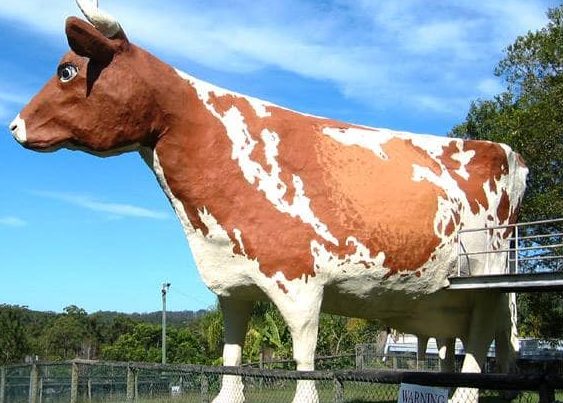
Poor little Rael was messed up in the head, believing that he would go to hell after he was dead. There is one more thing, “Be here now” and a photo for the Hindus of a big sacred cow.

The Big Cow at Yandina, Queensland, Australia