animals, book, poetry

Dive into the Surreal: A New Zine of Poetry and Art

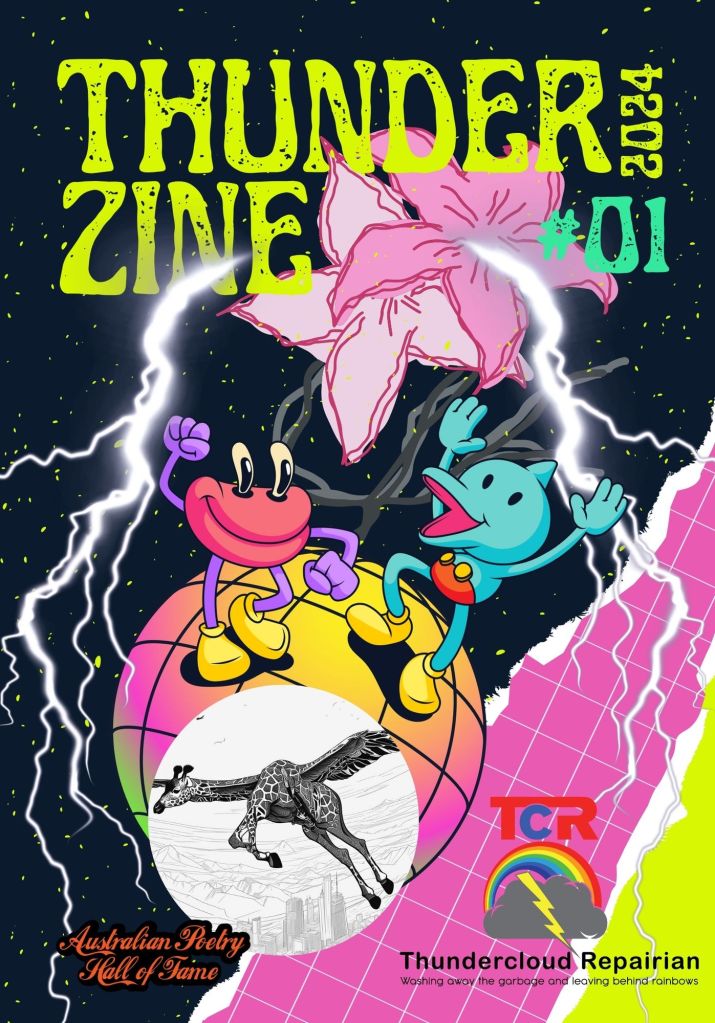
Thunderzine #01 Out Now

Explore the vibrant and colourful surreal poetry and artwork of Thundercloud’s Thunderzine#01

Are you ready to embark on a journey beyond the ordinary? My latest creation, a zine brimming with surreal poetry and art, has just been released!

This unique offering is a playground for the imagination. Within its pages, you’ll encounter poems that dance with dreamlike imagery and art that bends reality in captivating ways. It’s a space to lose yourself in the beauty and absurdity of the surreal.

Calling all fans of the strange and wonderful!

Whether you’re a seasoned explorer of the surreal or just dipping your toes into the unknown, this zine is for you. It’s a chance to experience the world through a different lens, to be surprised and delighted by the unexpected. You will discover what it is like to become a flying giraffe amongst other things.

Want your own copy?

For just $5 plus postage, you can own a piece of the surreal. Contact me directly at 1english1@gmail.com to secure your copy.

Don’t miss this opportunity to delve into a world where the ordinary is defied and the extraordinary takes centre stage. Let my surreal zine ignite your imagination and transport you to a place where anything is possible.

Get your own copy of the artwork or have it shipped directly to you. Don’t miss out on this unique artistic experience! #SurrealArt #Thunderzine #ArtExhibition #AustralianPoetry #ColourfulArt #ArtCollectors #CreativeCommunity #ArtLovers #PsychedelicArt #ArtInspiration

animals, change, health, Life lessons

Replacing Habits: Pulling Bad Habit Rabbits Out for Positive Change

Download begins 1 January 2020 12:34am.

Thirty Four minutes into New Years Day, admittedly I had taken a gut full of magic mushrooms and the download occurs. “We are all born with 100 bad habit rabbits up our bum and when they are hungry they stick their heads out and growl. We feed them and they lay content and silent until they reawaken. The goal, shit them out and replace them with happy good habit rabbits that you need to feed.” (Thundercloud Wisdom)

Two days later, I left Rose, Fantasian Eatery our restaurant in Nimbin and went home to begin publishing the poetry that I had written. Jump forward twelve months and I am now living in Guyra running the Australian Poetry Hall of Fame and on the 1st of January 2021 I wrote the following poem.

The Rabbits

A Resolution Was made to shit out my rabbits

The bad habit rabbits and grow good habit rabbits

Because new good habits were what I needed to do

I said “Hasta la Vista baby” on January Two

“see you later princess, I’ve Dragons to slay

So you’re dropped like a bad habit, I’m going away”

I took my peace and love then left with a BOOM

Left a bad habit rabbit ranting in her dining room

Shat a bad habit rabbit out when I did a poo

Fed a new good habit rabbit in its place it grew

Found a town where the new good habit rabbits walked around

Settled down and said farewell to bad habit rabbit town

Make my bed in the morning, exercise and clean my room

All because last new years eve I ate a blue mushroom

The message from the mushroom was something like this

Shit out your bad behaving rabbits and they won’t be missed

Feed your good habit rabbits lettuce and sit them in the sun

Because good habit rabbits love feeling good and also having fun

Another year is here and time to shit me rabbits

Introspect, self reflect and eliminate old bad habits

Plant new good habit rabbit seeds after my last fart

Nurture them and water them with love from my heart

Going forward in the year with good habits that are new

New healthy behaviours adopted and grown by 2022

Here we are in 2024 and one of the bad habits that I had fallen into was waking in the morning and scrolling short videos before I get up to do my yoga and meditation. Upon identifying this pattern I decided not to look at my phone until after yoga and then go for a walk and listen to “Headway” book summaries. Some of the summaries that I have listened to are: “The Power of Habit” by Charles Duhig, “The 7 Habits of Highly Effective People by Stephen R. Covey and “Atomic Habits” by James Clear.

I have provided a summary below of what I have learnt so far and finish with my latest piece of “habit poetry” “Rabbits Part 2”

Pulling the Bad Habit Rabbits Out of My Ass

 Outline

1. Introduction

   – Overview of the metaphor

   – Importance of habits in daily life

2. Understanding Bad Habits

   – Definition of bad habits

   – Examples of common bad habits

3. The Metaphor of Bad Habit Rabbits

   – Explanation of the metaphor

   – Why visualise habits as rabbits?

4. Identifying Your Bad Habit Rabbits

   – Self-awareness and self-assessment

   – Techniques to identify bad habits

5. The Impact of Bad Habits on Life

   – Physical health consequences

   – Mental and emotional effects

   – Social and professional impacts

6. Why It’s Hard to Get Rid of Bad Habits

   – The science behind habit formation

   – Psychological attachment to bad habits

7. Pulling the Bad Habit Rabbits Out

   – Strategies for breaking bad habits

   – Real-life examples of habit breaking

8. Replacing Bad Habit Rabbits with Good Ones

   – The concept of healthy rabbits

   – Steps to replace bad habits with good ones

9. Conditioning the Good Habit Rabbits

   – Importance of conditioning

   – Techniques for maintaining good habits

10. Feeding the Good Habit Rabbits

    – Consistency in good habits

    – Positive reinforcement methods

11. The Role of Support Systems

    – Family and friends

    – Professional help and therapy

12. The Journey of Self-Improvement

    – Setting realistic goals

    – Tracking progress

13. Success Stories

    – Inspirational stories of habit transformation

    – Lessons learned from others

14. Common Mistakes in Habit Change

    – Pitfalls to avoid

    – Tips for overcoming setbacks

15. Conclusion

    – Summary of key points

    – Encouragement for continuous self-improvement

16. FAQs

    – How long does it take to break a bad habit?

    – What are some effective methods for habit change?

    – Can bad habits be completely eliminated?

    – How do I stay motivated during the process?

    – What if I relapse into old habits?

 Pulling the Bad Habit Rabbits Out of My Ass

 Introduction

We’ve all heard of pulling rabbits out of hats, but pulling bad habit rabbits out of your ass? Now that’s a trick worth learning! Habits, whether good or bad, significantly shape our daily lives. This whimsical metaphor illustrates the struggle of getting rid of pesky habits that do us no good and replacing them with ones that enrich our lives.

 Understanding Bad Habits

Bad habits are those repeated actions or behaviour that negatively impact our lives. They can range from smoking and overeating to procrastination and excessive screen time. While these habits might offer temporary comfort or satisfaction, their long-term effects can be detrimental.

 The Metaphor of Bad Habit Rabbits

Why visualise habits as rabbits? Because rabbits are prolific and, when unchecked, can multiply rapidly. Just like these furry creatures, bad habits can quickly take over various aspects of our lives if not managed. Seeing these habits as rabbits makes the concept tangible and helps in visualising the process of removal and replacement.

 Identifying Your Bad Habit Rabbits

The first step in breaking free from bad habits is self-awareness. Take a moment to reflect on your daily routines and identify actions that negatively impact your well-being. Keep a journal or use habit-tracking apps to pinpoint these behaviour. Techniques such as mindfulness and meditation can also aid in recognizing these habits.

 The Impact of Bad Habits on Life

Bad habits can wreak havoc on your physical health, leading to issues like obesity, heart disease, and chronic fatigue. Mentally, they contribute to stress, anxiety, and depression. Socially, they can strain relationships and hinder professional growth. Recognizing these impacts underscores the urgency of addressing them.

 Why It’s Hard to Get Rid of Bad Habits

Breaking bad habits is challenging because they are deeply ingrained in our neural pathways. The brain loves routine, and changing these patterns requires significant effort. Additionally, bad habits often provide immediate gratification, making it harder to resist their allure.

 Pulling the Bad Habit Rabbits Out

To effectively pull out these bad habit rabbits, you need a strategy. Start by identifying triggers and replacing the habit with a healthier alternative. For example, if stress triggers you to smoke, try taking a walk instead. Gradual reduction and positive reinforcement can also be powerful tools. Real-life examples include people who successfully quit smoking by gradually reducing their intake or replacing it with nicotine patches.

 Replacing Bad Habit Rabbits with Good Ones

Once you’ve yanked out those bad habit rabbits, it’s time to bring in the good ones. Healthy habits can include regular exercise, balanced diets, reading, or even daily meditation. Start small and build on each success. For instance, if you want to start exercising, begin with a 10-minute walk each day and gradually increase the duration.

 Conditioning the Good Habit Rabbits

Conditioning is crucial for maintaining these good habits. Consistency is key. Set a schedule and stick to it. Use reminders and set achievable goals. Celebrate small victories to keep yourself motivated.

 Feeding the Good Habit Rabbits

Just like rabbits need food to thrive, good habits need consistent effort. Positive reinforcement, such as rewarding yourself for sticking to a habit, can strengthen your commitment. Surround yourself with positive influences and avoid environments that trigger old habits.

 The Role of Support Systems

No one is an island, and having a support system can make a huge difference. Share your goals with friends and family. Join support groups or seek professional help if needed. Therapy can provide tools and techniques for dealing with deeply rooted habits.

 The Journey of Self-Improvement

Self-improvement is a continuous journey. Set realistic goals and track your progress. Celebrate milestones and don’t be too hard on yourself if you slip. Remember, every step forward, no matter how small, is progress.

 Success Stories

Hearing from others who have successfully transformed their habits can be incredibly motivating. Look for inspirational stories and learn from their experiences. These narratives can provide valuable insights and encouragement.

 Common Mistakes in Habit Change

Changing habits is not a linear process. Common mistakes include setting unrealistic goals, not having a clear plan, and not seeking support. Avoid these pitfalls by being patient with yourself and adjusting your strategies as needed.

 Conclusion

Pulling the bad habit rabbits out of your ass and replacing them with good ones is no small feat, but it’s entirely possible with the right mindset and strategies. Start small, stay consistent, and seek support when needed. Your journey towards better habits is a marathon, not a sprint, so pace yourself and enjoy the process.

Bad Rabbits

Pulling the bad habit rabbits out of my ass

I feel so much more comfortable after they pass

Replacing them with healthy rabbits like conditioning

Feeding the good habit rabbits like going to gym

I took out a bad habit rabbit, had an empty feeling

Replaced it with a good habit rabbit as part of my healing

I used to sit and watch, now I plan, act and do

Fast and eat much less and I have more energy too

But there are still bad habit rabbits screaming inside

FEED US We are your dark side you cannot hide

There are times that I feed them just to shut them up

And then I justify to myself that it’s ok to fuck up

It’s not because personal growth is a journey of every day

Change and self improvement in each and every way

And those bad habit rabbits are just patterns learned

Good habit rabbits come from willingness to grow, change, and lessons learnt

 FAQs

How long does it take to break a bad habit?

Breaking a bad habit typically takes anywhere from 21 to 66 days, depending on the individual and the habit.

What are some effective methods for habit change?

Effective methods include identifying triggers, replacing the habit with a healthier one, and using positive reinforcement.

Can bad habits be completely eliminated?

While it’s challenging to completely eliminate a habit, it can be significantly reduced and managed with the right strategies.

How do I stay motivated during the process?

Staying motivated involves setting realistic goals, celebrating small victories, and seeking support from friends, family, or support groups.

What if I relapse into old habits?

Relapses are common. Don’t be too hard on yourself. Reflect on the triggers that caused the relapse, adjust your strategy, and keep moving forward.

change, Life lessons, poetry, politics, writing

The Parable of the Owl who thought he knew better.

I have just finished reading Dr Thomas Sowell’s seminal work, “Intellectuals and Society,” in which the author posits a central thesis that challenges the undue influence of contemporary intellectuals on public discourse and policy. Sowell’s critique rests on several key premises:

1. Epistemological Hubris: Intellectuals, particularly those subscribing to specific ideological frameworks, often exhibit an inflated confidence in their knowledge and proposed solutions to societal problems. This overreliance on centralized planning and state intervention, Sowell argues, can have detrimental unforeseen consequences.

2. Empirical Neglect: He emphasizes the importance of grounding intellectual pursuits in robust empirical evidence and historical context. Criticisms are levied against intellectuals for selective data analysis, neglecting opposing viewpoints, and dismissing inconvenient realities that contradict their preferred narratives.

3. Idealistic Abstractions: The book contends that intellectuals are often drawn to utopian visions of social justice without adequately considering the complexities of real-world implementation and potentially negative downstream effects. Sowell champions a more pragmatic approach focused on achievable improvements informed by evidence and existing institutional frameworks.

4. Collectivist Biases: He criticizes the tendency of intellectuals to prioritize collective identities (race, class, gender) over individual agency, often attributing individual struggles solely to pre-existing systemic factors. Sowell advocates for a greater emphasis on personal responsibility and initiative as crucial factors in individual advancement.

While acknowledging the valuable role intellectuals can play in contributing insights and stimulating debate, Sowell ultimately calls for a more measured and evidence-based approach to intellectual discourse and policymaking. His core thesis prioritizes individual agency and pragmatic solutions over grand ideologies and simplistic diagnoses of societal issues.

However, it’s crucial to acknowledge that “Intellectuals and Society” has generated both praise and criticism. While some celebrate its critique of intellectual arrogance and its focus on historical context and individual agency, others have challenged its broad generalizations about intellectuals, its selective use of evidence, and its perceived ideological bias.

In order to wrap my head around the ides presented, I have written the following parable about an owl who gets rid of all the tree leaves so that the forest floor can receive an equal amount of sunlight.

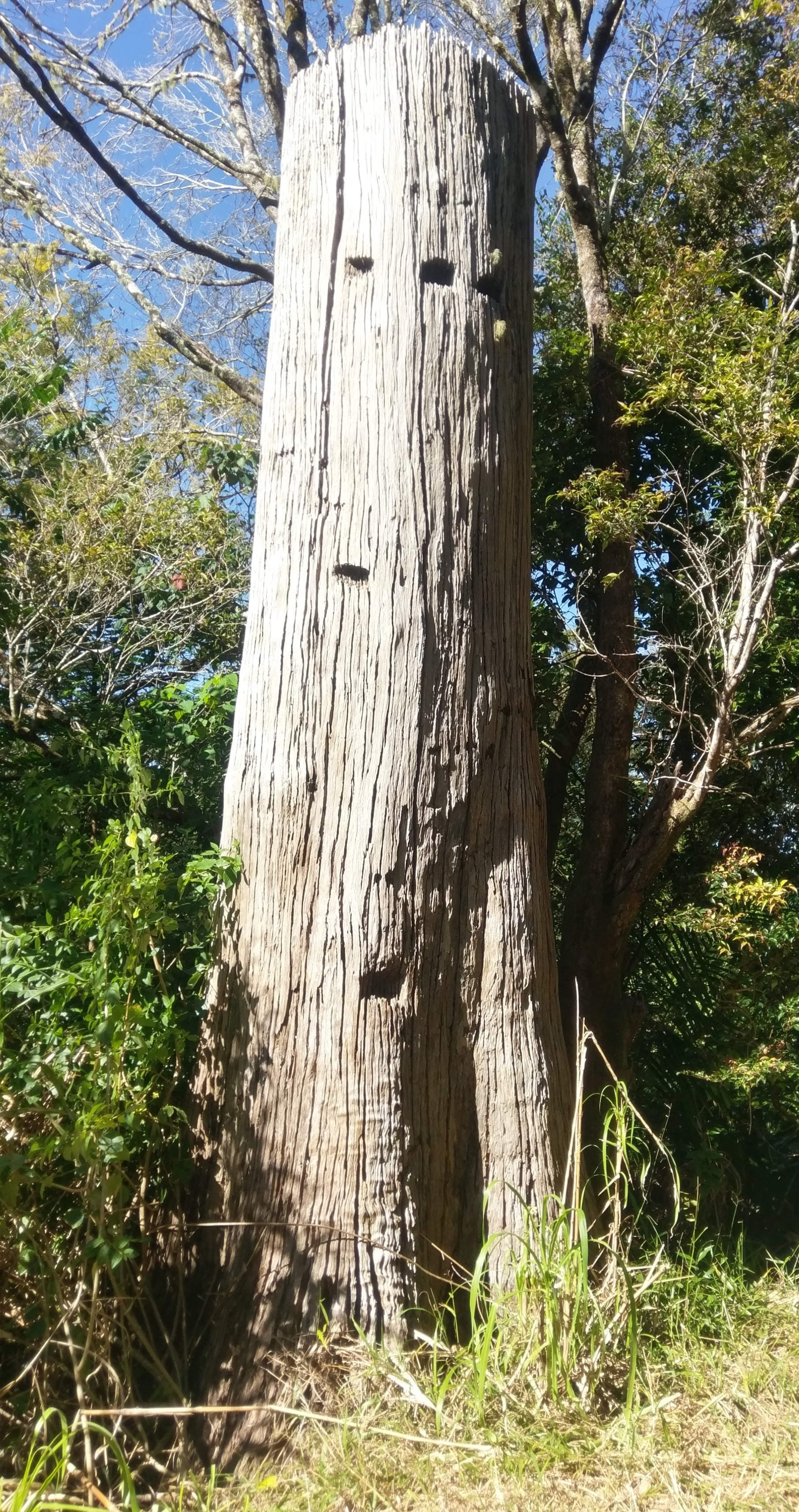
big tree stump
giant old tree stump

The Parable of the Owl who thought he knew better.

 Or (The double edged sword of intellectual arrogance)  

In emerald halls where sunlight dared not tread, 

where ancient oaks held secrets whispering low, 

Hootah the Owl, with wisdom’s crown upon his head, 

Preached of shadows where the forest should not grow.

His feathered form, a tapestry of speckled night,

His voice, a siren’s song in boughs of aged might,

 He spoke of trees that hoarded golden rays, 

And creatures veiled in gloom, denied their rightful days.

The forest stirred, a ripple of discontent, 

From timid mouse to stoic, lumbering ox, 

Hootah’s words, a firebrand heaven-sent, 

Ignited dreams of light beyond the locks.

He promised justice etched in sunlit lines, 

A grand utopia where shadows dared not creep, 

With shears of justice and with boughs entwined, 

He vowed to banish gloom from slumber’s deepest sleep.

The rabbits danced, their fur ablaze with hope, 

The squirrels clambered, eager to enforce the decree,

But Sowell the Ox, wise with seasons’ patient scope, 

Felt doubt’s first tremor touch his ancient knee.

He’d seen the scars of grand designs laid bare, 

The unintended thorn that grew with borrowed light, 

The parched earth gasping ‘neath a denuded lair, 

Where once the shade had held the sun at bay just right.

But Hootah’s fervor drowned the whispering fear, 

His pronouncements rang like gongs upon the breeze, 

And doubt was swept away, a tear uncried, unnear, 

As branches were chopped, a sacrifice to sunlit ease.

And for a time, the forest shimmered bright, 

The undergrowth, a canvas newly spun,

 But soon the cracks of error came to light, 

As withered branches mocked the rising sun.

The parched earth cracked, a thirsty song, 

The rabbits searched for solace in the dust, 

The squirrels clung to limbs, skeletal shadows long, 

Their dreams of plenty transformed to disgust.

Then Sowell, voice a rumble from the ground, 

Spoke truths etched deep in roots and ancient bark,

 “Hootah’s grand design, with fetters tightly bound, 

Can only steal the dance of darkness and the dark

Of nature’s own design, where sun and shade conspire

 To weave a tapestry where life, in balance, thrives, 

No single thread, however bathed in fire,

 Can mend the broken loom where every creature strives.”

His words, a balm on fevered forest dreams,

Awoke the doubt that Hootah’s vision hid, 

Squirrels’ lost their grip and rabbits’ angry screams, 

A barrage of questions, unanswered by the whizz-kid

Hootah, perched upon his throne of withered pride,

 Saw shadows creeping back to claim their due,

 His grand design, by nature’s hand defied,

His promises dissolved like morning dew.

And so the forest healed, with lessons learned at last, 

That harmony, not schemes, will guide the light, 

That Sowell’s wisdom, whispered on the blast, 

Is nature’s truest song, sung clear and bold and bright.

This tale, a whispered echo in the leaves, 

A song of shadows woven with the sun, 

Reminds that grand designs, like fallen sheaves, 

May wither in the soil where balance has begun.

Can you help the Australian Poetry Film Contest?

Oz on Screen: A Poetry Film Feast in Guyra

Calling all poets and film fanatics! Get ready for the 2024 Australian Poetry Film Festival, a November bash celebrating words on screen in Aussie style. Imagine outback landscapes in motion, love poems whispered by waves, and bush ballads brought to life with modern magic.

This Guyra event welcomes everyone – young, old, poets, filmmakers, all! We especially love fresh takes on our rich bush poetry tradition. Think vibrant images, powerful verses, and stories that crackle with Aussie spirit.

Plus, the festival joins forces with “Poets on the Mountain,” so expect workshops, panels, and screenings under starry skies. It’s a creative melting pot where you’ll meet passionate folks and see the future of storytelling unfold.

But to make this poetry party pop, we need your help! We’re crowdfunding to boost prize money for Best Australian Poetry Film, Best Bush Poetry Film, and even Best Student Poetry Film. Every bit fuels filmmakers’ dreams and lets them share their visions with the world.

So, whether you write rhymes, love movies, or just adore Aussie tales, join us! Submit your film, donate to the cause, or simply come to Guyra in November and witness the magic. Let’s bring poetry to life, one frame, one verse, one epic story at a time!

For film submissions and crowdfunding details, visit:

health, Life lessons, poetry, politics, Uncategorized

Body Positivity and Objectification Isn’t All Bad

When I looked in the mirror last year I didn’t like what I had become…..weak and overweight. This was not like how I want to see myself and it’s also not how I want other people to see me, As a father of sons and also a public figure it’s important to present an image of health and wellness as I have always been one to lead by example and not one to tell other people how to live their lives. I also have a father who has been a very good role model of what can happen when unhealthy dietary habits catch up on you as he had part of his bowel removed when I was young due to diverticulitis. So in my teenage years I adopted healthy eating such as fruit for breakfast and avoiding high energy, nutrient deficient processed food. One of my majors was environmental pollution and health so I have always tended to eat healthily and avoid chemical pollutants.

This year, 2023, I have leveled up my health and fitness training because I didn’t like the look of my reflection nor the numbers on the scales. So I restarted swimming 2 or 3 times per week, I am lifting in the gym 3 or 4 times a week as well as my daily breathing, meditation and yoga routine. I have also begun eating less bread and high glycemic index foods. The results are showing and although I’v only lost about 4 kilograms, most of the fat has been converted to muscle so I am visibly slimmer and stronger.

Why am I telling you this? The Guyra Ag Show is coming up and there are prize categories for Guyra Show Girl and Guyra Show Guy, I said half joking (because in all humility, I think I’d have a good chance at winning) that I could go in it to a friend. She was horrified and ranted about how the Australian of the year got her award for the work she’s done about “stopping the objectification of people. ” She was so insenced by the “Guyra Show Guy” competition that she said she was going to write to the “Guyra Show Society” She’s wrong, the Australian of the year is documentary director Taryn Brumfitt who leads the Body Image Movement, an Adelaide-based organisation that teaches people to look after, love and appreciate their bodies. It is a body positivity movement that Taryn Brumfitt leads.

This lead me to doing my own research on the objectification of people and looking at both sides of the argument. I will begin by arguing why the objectification of people can be harmful and then I explore arguments why is is OK for a man to objectify himself and then how self objectification by women is sexually empowering.

Why objectification of some people is harmful.

The objectification of individuals, regardless of gender, is a harmful practice that reduces a person to nothing more than a physical object for others to admire or desire. However, the objectification of men and women is different in both its form and consequences.

The objectification of women has been a widespread issue for centuries and is still prevalent in today’s society. Women are often objectified through the media, advertisements, and other forms of popular culture, where they are shown as passive objects for the male gaze. This type of objectification often sexualizes women’s bodies and reduces them to nothing more than objects for sexual pleasure. The consequences of this type of objectification can be damaging to a woman’s self-esteem, self-worth, and can lead to a negative body image.

On the other hand, the objectification of men is a more recent phenomenon that has been brought to light in recent times. Unlike the objectification of women, which often sexualizes their bodies, the objectification of men tends to focus on their physical strength and athleticism. This can be seen in advertisements and media that depict men as strong and muscular, promoting a particular type of masculinity. While this type of objectification may seem less harmful, it can still have negative consequences. For example, it can contribute to the pressure on men to conform to a particular body type, leading to anxiety and body shaming.

Furthermore, while both men and women are objectified, the consequences of this objectification are not equal. The objectification of women is often tied to sexism, misogyny, and the patriarchal system, which is why it can lead to gender-based violence and discrimination. On the other hand, the objectification of men is tied to toxic masculinity and the pressure to conform to traditional masculine gender roles, which can lead to harmful behaviours such as aggression and the suppression of emotions.

In conclusion, the objectification of men and women is different in both its form and consequences. While both are harmful, the objectification of women is can be tied to sexism and misogyny, while the objectification of men can be tied to toxic masculinity. It is important to acknowledge these differences and some people think it is important to work towards ending the objectification of all individuals, regardless of gender. This could be achieved through the promotion of body positivity, challenging harmful societal norms and expectations, and educating people about the harmful consequences of objectification.

How self objectification by men promotes body positivity.

The objectification of individuals, whether it is someone else objectifying them or themselves, is often seen as a negative and harmful practice. However, there is a growing argument that self-objectification can be a positive and empowering experience for some individuals, including men. In this essay, I will argue that it is okay for a man to objectify himself and explain why.

Self-objectification is a process in which an individual evaluates themselves based on their physical appearance and sexual desirability. For men, this can involve striving for a particular body type or physical appearance that they believe will make them more attractive to others. While this may seem like a negative practice, some argue that it can be a form of self-expression and a way for men to assert their individuality and control over their bodies.

For example, some men may objectify themselves in order to feel more confident and assertive. By focusing on their physical appearance and striving to achieve a particular body type, they may feel a sense of pride and empowerment. This can lead to improved self-esteem and a more positive body image, which can have a positive impact on mental health and well-being.

Moreover, self-objectification can be a way for men to express their sexuality and explore their sexual desires. By focusing on their physical appearance and sexual desirability, they may feel more comfortable and confident in their sexual identity and expression. This can lead to a more fulfilling and enjoyable sexual life, which is an important aspect of overall well-being.

It is also important to note that self-objectification is a personal choice and individual experience. While it may not be right for everyone, it is important to respect an individual’s right to choose how they want to present themselves and express their sexuality. The pressure to conform to traditional masculine gender roles can be harmful and restrictive, and self-objectification can provide a space for men to reject these norms and assert their individuality.

In conclusion, while the objectification of individuals is often seen as a negative and harmful practice, it is okay for a man to objectify himself. This can be a form of self-expression, a way to assert individuality and control over their bodies, and a way to explore their sexuality. As long as it is a personal choice and not used to harm others, self-objectification can be a positive and empowering experience for some men.

Can Self Objectification by Women be Sexual Empowerment?

The objectification of individuals, particularly women, has long been seen as a negative and harmful practice. However, in recent years, there has been a shift towards a more accepting and even celebratory view of women who objectify themselves. This essay will explore why it is becoming more acceptable for a woman to objectify herself.

One reason is the rise of the body positivity movement, which encourages individuals to love and embrace their bodies, regardless of shape or size. This movement has challenged traditional beauty standards and encouraged people to see their bodies as something to be celebrated rather than criticised. This has created a more accepting and inclusive environment for women who choose to objectify themselves, whether it is through posting sexy selfies or showing off their bodies in tight-fitting clothing

Another reason is the increasing visibility and representation of women in popular culture, who objectify themselves. From music videos to reality TV shows, women are increasingly presenting themselves in sexually suggestive and provocative ways. This has led to a normalisation of women objectifying themselves, and a greater acceptance of this type of self-expression.

Furthermore, the rise of social media has allowed for women to have greater control over their self-presentation and objectification. Through platforms such as Instagram, women can curate and control their online image, and choose to present themselves in a sexually suggestive or objectifying way if they so choose. This has given women greater agency over their self-expression and has made it more acceptable for them to objectify themselves.

It is also important to note that self-objectification can be a form of empowerment and self-expression for some women. By choosing to present themselves in a sexualised or objectifying way, they are asserting their individuality and control over their bodies. This can lead to a greater sense of confidence and body positivity, which can have a positive impact on mental health and well-being.

In conclusion, it is becoming more acceptable for a woman to objectify herself due to the rise of the body positivity movement, the increasing representation and visibility of women who objectify themselves in popular culture, and the greater control and agency provided by social media. While self-objectification may not be right for everyone, it is important to respect a woman’s right to choose how she wants to present herself and express her sexuality.

Poetry: When Body Positivity Meets Gaslighting.

When body positivity meet gaslighting. (Satire) While researching for the above article I came across some phrases used to promote body positivity and also some phrases used to “body shame” and thought what would happen if you combined the body positivity phrases with the body shaming phrases. This is meant purely as satire.

“You are beautiful just the way you are but you’re too skinny/fat”

“Your body is amazing and you need to lose weight”

“Although you’re not toned enough you are worthy of love and respect, regardless of your size or shape.”

“Your body is a temple with love handles and cellulite treat it with care and respect.”

“You are more than your appearance and your flabby arms and legs.”

“Your body is strong and capable even with a muffin top.”

“Embrace your unique features, imperfections and thick waist, they make you who you are.”

“Focus on what your body can do, not your small breasts, big butt and double chin..”

“Health and happiness are more important than any physical characteristic like your ugly face”

“Your body is a work of art with a big belly, created perfectly for you.”

“Be kind to yourself and your body, it’s the only two you have. “

“Your body and thunder thighs are a reflection of the amazing person you are.”

“You need to work on your abs and acne but you are enough, just as you are.”

“Every body is a good body except that you have bad posture.”

“Your body is a source of pride and joy with a pot belly”

“You deserve to feel confident and comfortable in your own dry, flaky and wrinkly skin.”

“Celebrate your body for all the amazing things it allows you to do like sit and watch TV.”

“Focus on nourishing and loving your body, not changing your flat butt.”

“Your body is perfect in its own unique way with that squashed face and no teeth. “

“Remember, beauty comes in all shapes and sizes even very wide hips.”

And that is that…. Except the last thing that I wanted to say is that we are currently in the most unhealthily obese period in human history with over 50% of the entire population of the planet overweight or obese. That sure is one big opportunity for improvement. Stay well and let me know what you think in the comments.

animals, poetry, writing

What’s a “bogan” dad?

The term “bogan” is a term that originated in Australia and has been used to describe a particular subculture within the country. The word has been in use for several decades and has undergone a number of transformations in meaning over time.

The exact origin of the term is uncertain, but it is thought to have first been used in the 1970s as a slang term to describe a person who was perceived as being unrefined or lacking in taste or cultural awareness. This person was typically seen as being working-class and having a distinctive Australian accent. The term was often used to describe people who lived in the suburbs or outer regions of cities, as well as those who were involved in motor sports or other working-class pursuits.

Over time, the meaning of the term “bogan” has evolved and become more complex. While it still retains its original connotations of being unsophisticated and lacking in taste, it has also come to be associated with a particular subculture that is often seen as being rowdy, loud, and unrefined. This subculture is often associated with heavy drinking, partying, and other forms of reckless behavior.

Despite the negative connotations associated with the term, it has become an important part of Australian cultural identity and is widely used in the country. Many Australians embrace the term and use it in a self-deprecating or humorous manner, while others find it offensive and view it as an insult.

In recent years, the term “bogan” has become more widely known and has been used in other English-speaking countries. While its meaning and usage can vary in different countries, it remains a key part of Australian cultural identity and continues to be a subject of interest and debate.

In conclusion, the term “bogan” has a complex and evolving history in Australia. While it continues to be associated with negative stereotypes, it is also an important part of the country’s cultural identity and is widely used in a variety of different contexts.

Barry is a bogan known to his mates as Bazza

Bazza’s shag is a sheila called Sharon aka Shazza

They have a daughter named Karen, nicknamed Kazza

Daren is their son, often called Dazza

Now Bazza, Shazza, Kazza and Dazza live in Logan

Shazza has a loud voice, is never quietly spoken

Dazza loves billies but Kazza loves tokin’

Joints, VB, Commodores and Winnie Blue smokin’

Every night you’ll find Bazza at the pub

With his best mate known as “Grub”

Who walks along the street pickin’ up ciggie butts

Grub has this habit of playing with his nuts

Grub likes bare feet and Bazza wears thongs

When they’re pissed they love singing AC/DC songs

Cooking snags on the barbie with a pair of tongs

While Shazza and her girlfriends pack the fellas’ bongs

Dazza drifts his commodore around street bends

Kazza is always swearing and often offends

Bazza loves the massage parlour with his Asian girl-friends

An extra fifty bucks always ensures happy ends

By Thundercloud Repairian

This poem is meant as pure satire and if anyone takes offence, eat a bag of cement and harden up.